
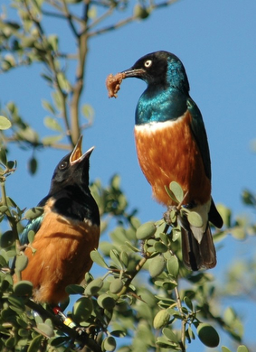
Latest paper, A cryptic role for reciprocal helping in a cooperatively breeding bird was published yesterday in the journal Nature. It’s an analysis of 20 years of field observations of African superb starlings. The key discovery is that both related and unrelated birds were taking turns for each other as ‘breeders’ and ‘helpers’ across their lifetimes, and that this phenomenon required decades of observation to be detected. The fieldwork was started about 25 years ago by Dustin Rubenstein when he was graduate student at Cornell. It is the centerpiece of the PhD dissertation of Alexis Earl, then a PhD student in Dustin’s lab at Columbia University, and now a postdoc fellow at Cornell. I am “co-first author” alongside Alexis due to my contributions to the writing and analysis, and I feel very lucky that Alexis and Dustin invited me on to collaborate on this incredible project. It was a fascinating and rich dataset, a challenging analysis, and a fun paper to write.
We wrote a summary here: Superb starlings swap helper and breeder roles with kin and non-kin. And the study was covered by several media outlets including the New York Times, Guardian, and New Scientist.
To be continued. I wrote much more telling the story of this paper, but ran out of time. So I will end this post here, and the rest will have to wait for a future post.


 Carter Lab