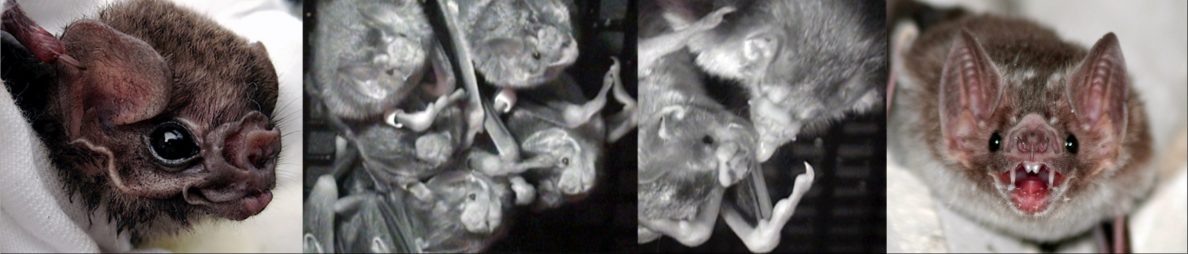
I recently wrote a paper with Dan Riskin entitled "The evolution of sanguivory in vampire bats: origins and convergences" (if you cannot access it, get it here). It's a review of the evolution of blood-feeding, which has occurred more than two dozen times among different animals, from mammals, birds and fishes to molluscs, crustaceans, and … Continue reading New paper: The evolution of blood-feeding
Category: News
New paper: Spatial learning overshadows learning novel odors and sounds in both a predatory and a frugivorous bat.
A guest blog post by Postdoc Dr. May Dixon on her recent paper. To what extent is animal learning shaped by selection from the challenges of foraging? One hypothesis poses that animals should learn about food differently depending on whether their food is spatially stable. Animals with spatially predictable food, like scatter-hoarders that refind caches, … Continue reading New paper: Spatial learning overshadows learning novel odors and sounds in both a predatory and a frugivorous bat.
I’m hiring a full-time research scientist
I'm hiring a full-time research scientist to lead our on-campus research program focusing on cooperative relationships among vampire bats in a captive colony at The Ohio State University, Columbus, Ohio. It's basically half lab manager, half research scientist. The position is currently funded for 5 years, but my intention is to renew it indefinitely (a permanent research … Continue reading I’m hiring a full-time research scientist
2022 in review
I just submitted my annual report to the National Science Foundation, so I thought I would share our progress here. Research We started a new captive colony of vampire bats at the Smithsonian Tropical Research Institute in Panama. This colony includes vampire bats captured from three different sites to make a mix of familiar (ingroup) … Continue reading 2022 in review
Vampire bats at Ohio State University!
After 4 years of effort, we finally brought vampire bats into our lab on campus on November 3. https://youtu.be/DpEDnNU-5Fs Video clip by May Dixon.
Thank You to everyone who helped with The Ohio Bat Festival
The Ohio Bat Festival on October 29 was a big success! At least 524 people attended, which is far more than we expected (our predictions ranged from 75 to 237 attendees). Despite our shoestring budget (just $1000 per year from the National Science Foundation), we put on a great event thanks to generous donations of … Continue reading Thank You to everyone who helped with The Ohio Bat Festival
The Ohio Bat Festival is coming October 29
The Carter Lab is hosting the first Ohio Bat Festival. Click here to learn more.
New paper: How often does rabies make vampire bats aggressive?
I have no expertise in epidemiology or disease ecology, but it's hard to ignore these important topics if you study vampire bats, which cause deadly rabies outbreaks throughout Latin America. Preventing rabies outbreaks is one of the most important reasons that scientists study vampire bats. Surprisingly, though, few studies look closely at how rabies actually … Continue reading New paper: How often does rabies make vampire bats aggressive?
New paper: Long-term memory in bats
Our newest postdoctoral researcher May Dixon and her co-authors (Patty Jones, Mike Ryan, me, and Rachel Page) have a new paper entitled “Long-term memory in frog-eating bats” in the journal Current Biology. The frog-eating bat (or fringe-lipped bat) is an acoustic eavesdropping predator that learns and remembers the calls of different frogs and katydids. As … Continue reading New paper: Long-term memory in bats
New paper: “Forced proximity promotes the formation of enduring cooperative relationships in vampire bats”
The latest paper from our lab by Imran Razik, Bridget Brown, and I can be found here at Biology Letters. This plot shows the experimental design. Imran let female vampire bats groom each other (network on left), then randomly selected bats to house together in a small cage for one week (middle), and then let … Continue reading New paper: “Forced proximity promotes the formation of enduring cooperative relationships in vampire bats”
 Carter Lab