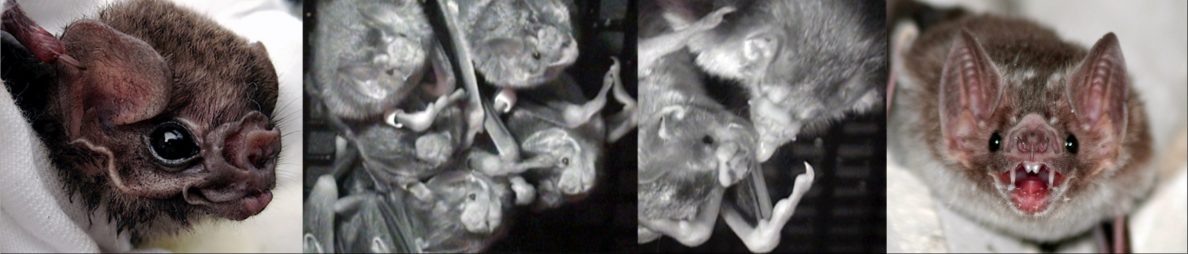
Jineth Berrío-Martínez (MSc in Biology) is a researcher from Colombia who arrived in April has been travelling around Panama to find additional wild vampire bat colonies. She is working on development of biting ability in young vampire bats. My research interests include tropical biology, population ecology, reproductive biology, evolution, and conservation. Early in my career … Continue reading Team Vampire, Spring 2017
Should we wipe out vampire bats?
Adam Cole from NPR visited our lab to shoot this great video short on human-vampire bat conflict. So "should we wipe out vampire bats?" No, even if we could, we shouldn't try, and frankly, nobody is actually suggesting exterminating vampire bats as a long-term solution. More on this topic in a previous post: Is killing … Continue reading Should we wipe out vampire bats?
Latest paper: social bet-hedging in vampire bats (and two other recent and related studies)
Our latest paper here. Also some early press here. There are actually three recent papers on social networks and the benefits of network size in primates (by Laurent Brent and co-authors), songbirds (by Josh Firth and co-authors), and bats (by me and co-authors): Family network size and survival across the lifespan of female macaques by L. … Continue reading Latest paper: social bet-hedging in vampire bats (and two other recent and related studies)
Latest paper: Reproductive seasonality, sex ratio and philopatry in Argentina’s common vampire bats
It can be found here. Summary: 35 years of field observations 13,642 mist-net captures and 181 whole roost captures vampire bats in Argentina (near the southern limit of their range) have a reproductive season (unlike most other places) we have new records for oldest wild vampire bats: 16 and 17 years we corroborated prior evidence … Continue reading Latest paper: Reproductive seasonality, sex ratio and philopatry in Argentina’s common vampire bats
A new field site in Panama
I am hoping to develop some new long-term field sites for future work on vampire bats. On March 27, I traveled with Austin Garrido, Rob Mies (director of the Organization for Bat Conservation), his daughter Georgia Mies, and labmates May Dixon, Rachel Crisp, Katharina Eggert, Hugo Narizano, and Julia Vrtilek to Lake Bayano, a two-hour drive … Continue reading A new field site in Panama
Update: three golden opportunities
Now - October 2017, the Smithsonian Institute has awarded me with a fellowship to finish collecting data from lab and field experiments on vampire bat social behavior with Rachel Page at the Smithsonian Tropical Research Institute in Panama. November 2017 - August 2018, the Humboldt Foundation has awarded me a fellowship to learn more about social network analysis, resampling … Continue reading Update: three golden opportunities
Reciprocity before Trivers
"New" ideas are rarely new. In science we stand on the shoulders of giants and whenever I read the works of the giants, I often find that many ideas or discoveries-- that I thought were "mine" or belonged to some more recent author-- were actually first described by Darwin or some other author from long … Continue reading Reciprocity before Trivers
Field notes on weekend trip to Costa Rica (with disc-winged bats!)
Spix's disc-winged bat Thyroptera tricolor has suction cups (yes, suction cups) on its thumbs, and it uses these to cling to the smooth surface of young, furled Heliconia leaves. I’ve wanted to see a disc-winged bat since I was about ten years old, and I finally got to see them this week while visiting Gloriana … Continue reading Field notes on weekend trip to Costa Rica (with disc-winged bats!)
New paper: risk exaggerates nepotism in vampire bats
Here's the paper. In evolutionary biology, we often draw a line between "altruism" and other cooperative traits. Altruistic traits are special in that they lead to a net cost to one's survival and reproduction. Some traits are clear cases: when a bee stings you it dies, so the suicidal bee sting is an altruistic trait. But … Continue reading New paper: risk exaggerates nepotism in vampire bats
‘Team Vampire’ Fall 2016
Julia Vrtilek (Biology, Amherst College, 2015) is studying the development of grooming and food-sharing networks in young-of-the-year vampire bats. What are your interests? I find it fascinating and awe-inspiring that “from so simple a beginning endless forms most beautiful and most wonderful have been, and are being, evolved.” I’m interested in evolutionary biology, ecology, and animal … Continue reading ‘Team Vampire’ Fall 2016
 Carter Lab